Research and Funded Projects
Due to our commitment to innovative technology we are pursuing various engagements in research, development and standardization:
MERCI
Media and Event production via Resilient Communication on IoT Infrastructure
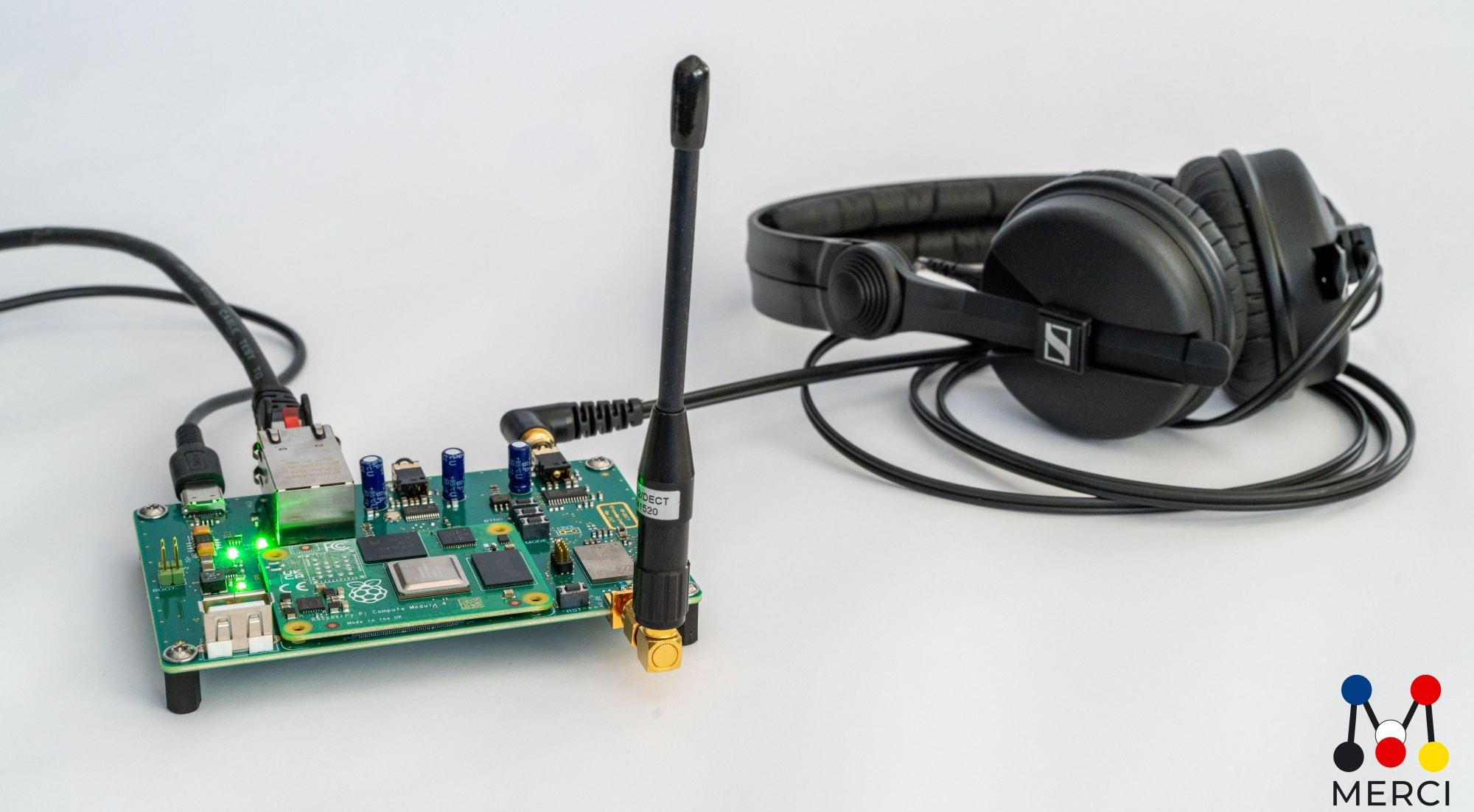
The MERCI project develops solutions for private 5G networks based on ETSI DECT-2020 NR, a new standard approved by ITU-R as an IMT-2020 technology and marketed by DECT Forum as DECT NR+. In cooperation with companies from the German and French event and media industry, RFmondial develops both hardware and software solutions based on System-in-Package solutions of the NRF91 series manufactured by Nordic Semiconductor. RFmondial designs PCBs customized for specific applications as well as dedicated firmware to build wireless networks according to the DECT-2020 NR standard. Our focus in MERCI are applications for event and media production, which require parallel transmission of multiple audio and video signals with DECT-2020 NR meeting tight latency and reliability requirements.
USWA
Ultra Scalable Wireless Access
The USWA project investigates approaches to combine low latency, high reliability and dynamically meshed network topologies for wireless technologies in 6G. For this purpose, different wireless technologies are studied with respect to media access, applicable protocols and advanced signal processing. RFmondial focuses on the investigation of DECT NR+, which is currently used for 5G, yet also offers potential for applications in 6G with its increased performance requirements. As a platform, both the System-in-Package solutions from Nordic Semiconductor's NRF91 series, as well as a Software-Defined-Radio implementation developed in cooperation with the project partner Leibniz Universität Hannover are used. For latency and reliability optimization, RFmondial evaluates advanced aspects of the DECT-2020 NR standard such as short symbol lengths, complex MIMO modes and their interaction with mesh functionality on the Data Link and Network Layer.

NATIVE-SSR
Native navigation system with SSR corrections for high-precision GNSS positioning
This project aims to implement two different approaches for native support of State Space Representation (SSR) correction data in GNSS receivers. First, the SSR format will be converted to the Observation Space Representation (OSR) format and then made available to the receiver. Second, a method will be implemented to process SSR correction data directly within the GNSS receiver and to correct the generated position solution directly. The project is carried out in cooperation with the Institute of Geodesy (IfE) of the Leibniz University of Hannover.
One of the advantages of SSR correction data is that it uses one-way communication, in contrast to the two-way communication required for OSR correction data. Furthermore, in the SSR format, the errors of individual conditions can be analyzed, such as atmospheric effects, whereas in OSR data, the total error is reported for the respective observation (pseudo-range, carrier phase measurement).
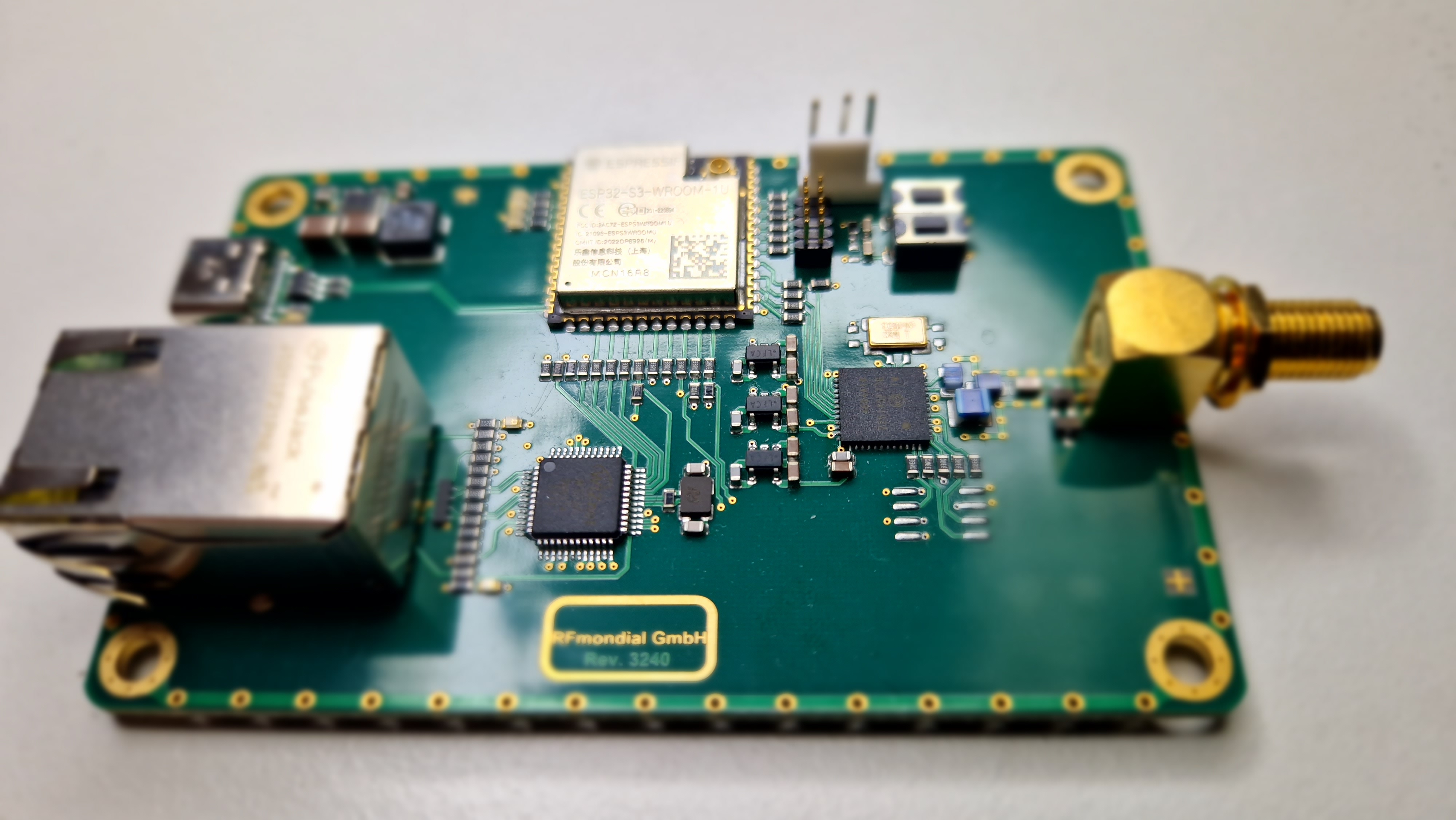
The previous project in cooperation with IfE has already demonstrated the feasibility of transmitting GNSS correction data via Digital Audio Broadcast (DAB). The DAB receiver module prototype developed there is to be further developed in this project and supplemented with the implementations described above. RFmondial GmbH is primarily responsible for the further development of the receiver module, while the IfE is responsible for the software implementation.
Previous research projects
- DAB+ SSR correction module: Development of a DAB-receiver module for GNSS correction (N-Bank)
- Rebroadcasting DAB+ in case of failure of distribution link (N-Bank)
- LADB: Linearization of Combined Analog and Digital Broadcasting Signal (BMWi)
- AI4Mobile: Data architecture, reduction algorithms and visualization for KI applications (BMBF)
- DRM+ diversity receiver together with the University of Hannover (BMWi)
- DRM+ field trial with transmit delay diversity and single frequency networks (SFN) - Project together with private regional radio broadcasters (Antenne Niedersachsen, radio ffn) and Bosch
- Evaluation of DRM+ technology in VHF Band III (174-230MHz)
- C-PMSE - The Cognitive Program Making Special Event (C-PMSE) project works towards the future and cooperative usage of the UHF spectrum. The project is organized in a consortium of research and industry and funded by the Federal Ministry of Economics and Technology (BMWi).
- Cross-compliance of DRM+ transmitter and receiver hardware
